
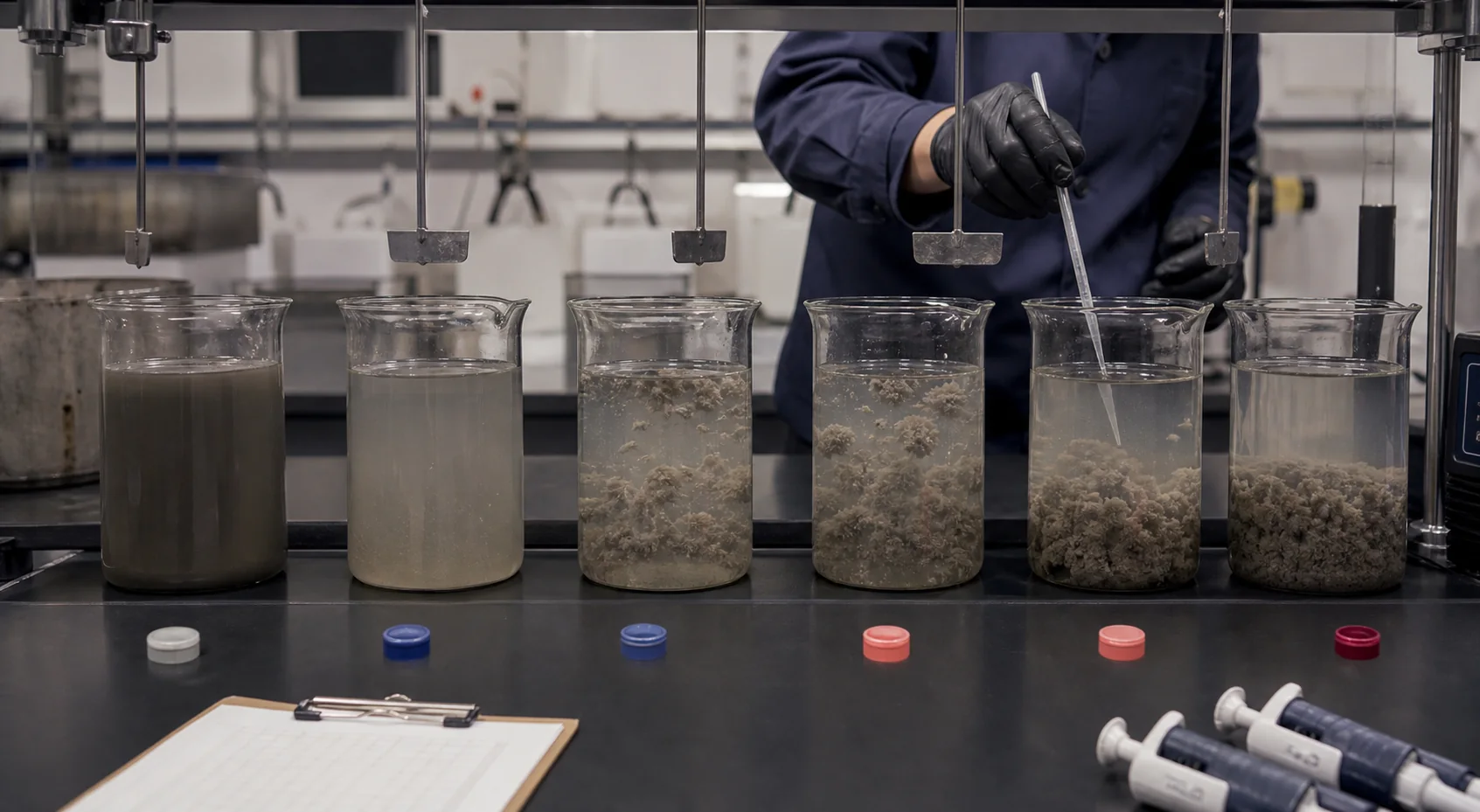
Start with the treatment duty
Wastewater clarification and sludge dewatering can occur in the same plant but involve different solids and equipment. One polymer should not be assumed to serve both duties.
Name the stream, stage and endpoint before comparing cationic and anionic candidates.
Use cationic PAM as an organic-sludge screen
Many biological sludges carry negative surface charge and often respond to cationic conditioning. Charge neutralization and bridging can release water and build a machine-tolerant network.
The required charge profile changes with digestion, volatile content, storage and equipment. Screen several candidates instead of treating high charge as automatically better.
Use anionic PAM after suitable destabilization
Anionic high-molecular-weight products often enter screening after metal-salt or organic coagulation has destabilized industrial wastewater particles. Their bridging reach can improve settling or flotation capture.
Confirm pH and primary coagulation first. Otherwise the test confounds two chemical decisions.
Reserve nonionic products for evidence-led cases
Low-charge or nonionic PAM can be considered for acidic, saline or unusual matrices where ordinary ionic families show weak or inconsistent response.
Include it as a comparison, not as a shortcut around wastewater characterization.
Compare at equal active dose
Powder, emulsion and solution products may have different active content. Comparing delivered volume or product mass alone can produce a false ranking.
Convert every test to active polymer and report the basis clearly. Keep solution concentration and age comparable.
Challenge shear and separation
The winning family must survive the plant's pump, inline mixer or centrifuge while producing the correct settling, flotation or drainage response.
Add a controlled shear step to screening and evaluate recovery. Test on the actual separator before supply approval.
Read failure symptoms
Persistent fine solids can indicate underdose, wrong charge, poor coagulation or poor preparation. Sticky floc and worse filtrate can indicate overdose, excessive charge or too much chain interaction.
Return to a blank and known reference, then change one variable. Do not chase every visual change with more polymer.
Compare product form without confusing chemistry
Powder and emulsion products can deliver similar ionic families through different preparation systems. Their inversion, active content, storage and feed equipment change the operating comparison.
Hold the intended ionic profile and active dose as consistently as possible, then compare preparation reliability, response time and total use cost.
Set a re-screening trigger
An approved cationic or anionic route can lose its advantage when industrial contribution, biological condition, digestion, coagulant program or separator duty changes.
Define which pH, solids, conductivity, volatile fraction or performance movement requires a new screen. This is more reliable than continuing to widen the dose range.
Include commercial constraints last
After the technical window is defined, compare active consumption, packaging, storage, documents, logistics and total treatment cost.
A cheaper delivered kilogram is not a better choice when it consumes more active polymer or raises sludge handling cost. Keep sample identity connected to the final quotation.