
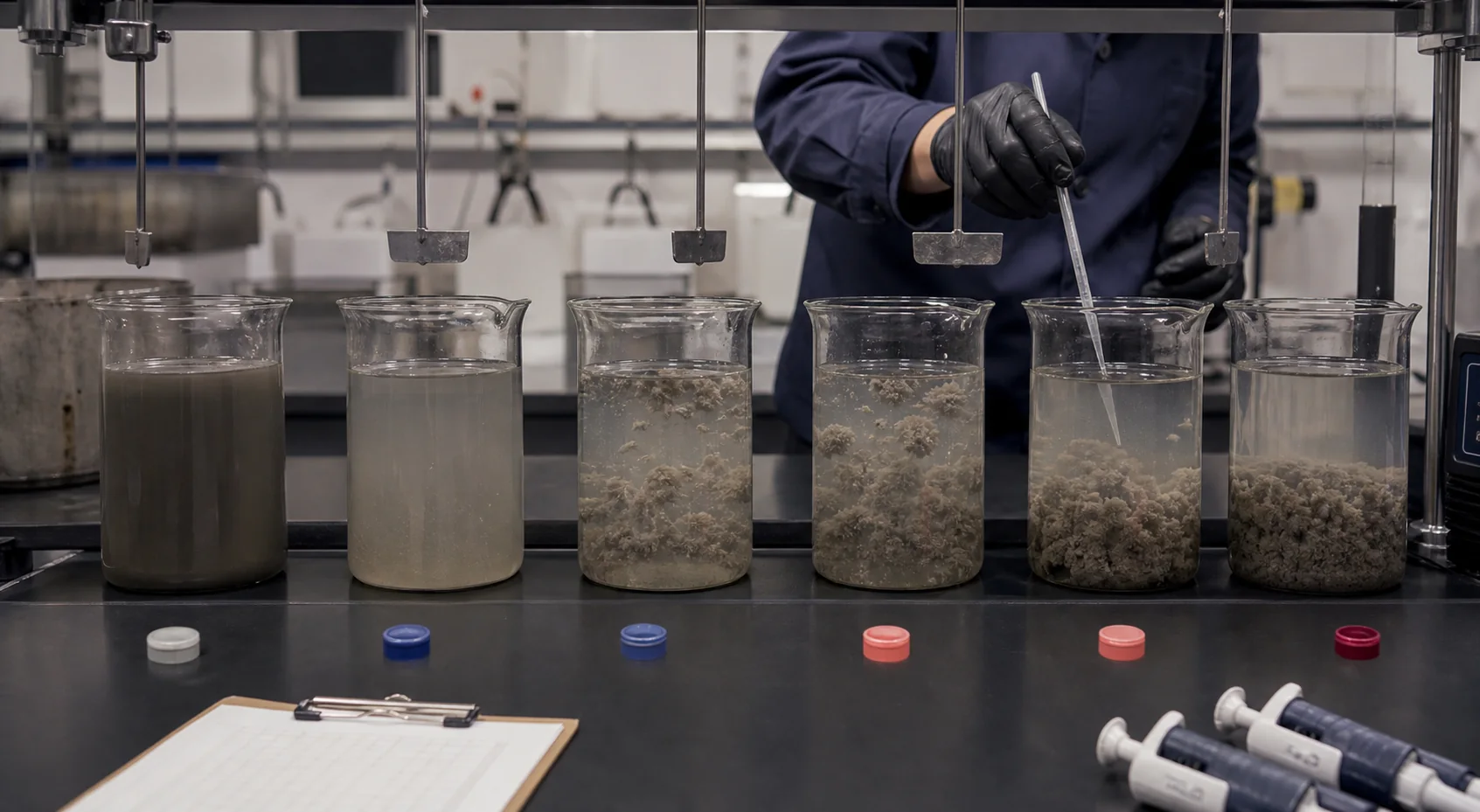
Collect a representative sample
Wastewater can change by shift, batch, storm, cleaning cycle and equalization level. Record source, time, temperature, pH, conductivity, TSS and relevant process indicators.
Run time-sensitive samples promptly and keep all comparison jars from the same well-mixed bulk sample.
Prepare candidates consistently
Make fresh polymer solutions according to the product instructions. Record active content, stock concentration, water quality, aging time and visual solution condition.
Reject solutions with gels or obvious undissolved material. Calibrate pipettes or dosing syringes before beginning the curve.
Fix upstream chemistry
If the treatment uses acid, alkali or coagulant, establish and hold those conditions across the polymer series. Include a no-polymer control.
This isolates polymer response from pH and coagulation changes.
Dose on an active basis
Choose a range wide enough to show underdose, useful response and overdose. Convert product additions to active polymer concentration rather than comparing liquid volumes.
Label every jar with product code and dose before addition to prevent transcription errors.
Reproduce the addition sequence
Distribute coagulant under rapid mix, then add diluted PAM at the intended point and reduce energy for floc development. Add every candidate at the same time and location relative to the impeller.
Avoid pouring concentrated polymer directly onto the water surface, which creates local overdose and poor dispersion.
Simulate the separator
For clarification, observe settling rate, supernatant turbidity and sludge volume. For DAF, use a relevant flotation or bubble-contact simulation. For dewatering, add drainage or capillary testing and later machine confirmation.
A generic settle test cannot approve every wastewater application.
Add a controlled shear challenge
Apply the same short high-energy step to promising jars when the plant has a downstream pump, constriction or high-shear mixer. Observe breakage and recovery.
Prefer a stable product-dose window over a spectacular but fragile floc.
Repeat the promising range
Repeat the best candidates on another representative sample and include a known reference. Record all endpoints and test conditions.
A repeat protects the decision from one unusual sample or mixing error.
Use sample blanks and field references
A no-polymer blank shows the untreated separation tendency, while the current plant product provides a reference against which new candidates can be judged. Both should receive the same upstream chemistry and mixing history.
If the reference fails unexpectedly, investigate sample age, coagulant condition and preparation before rejecting every candidate.
Create a decision sheet before the test
List product code, active dose, solution age, mix sequence, observations and measured endpoints in advance. Define which result constitutes failure and which range qualifies for repetition.
A prepared sheet reduces selective note-taking and keeps photographs, turbidity readings, settled volume and drainage observations tied to the correct jar.
Plan a bounded plant step test
Translate active dose, solution strength, addition sequence and mixing to full scale. Define stop limits, sampling locations and the residence time required before interpreting the change.
Make one controlled product or dose change at a time and retain the approved bench record.