
Confirm destabilization before polymer screening
Anionic polyacrylamide often acts as a bridging aid after metal-salt or organic coagulation has changed the particle surface. If pH and primary coagulant dose are not controlled, the polymer comparison measures an unstable coagulation step.
Establish a repeatable coagulant window first. Then add candidate PAM products at the intended point and preserve rapid mix, flocculation energy and separation time.
Choose a chain that survives the process
Molecular reach can help assemble destabilized particles, but excessively fragile floc may break in transfer piping or at a DAF recycle junction. High apparent viscosity is not proof of useful plant performance.
Compare floc build rate, shear recovery, settling or float response, treated-water turbidity and carryover after the real hydraulic stress.
Differentiate sedimentation and flotation
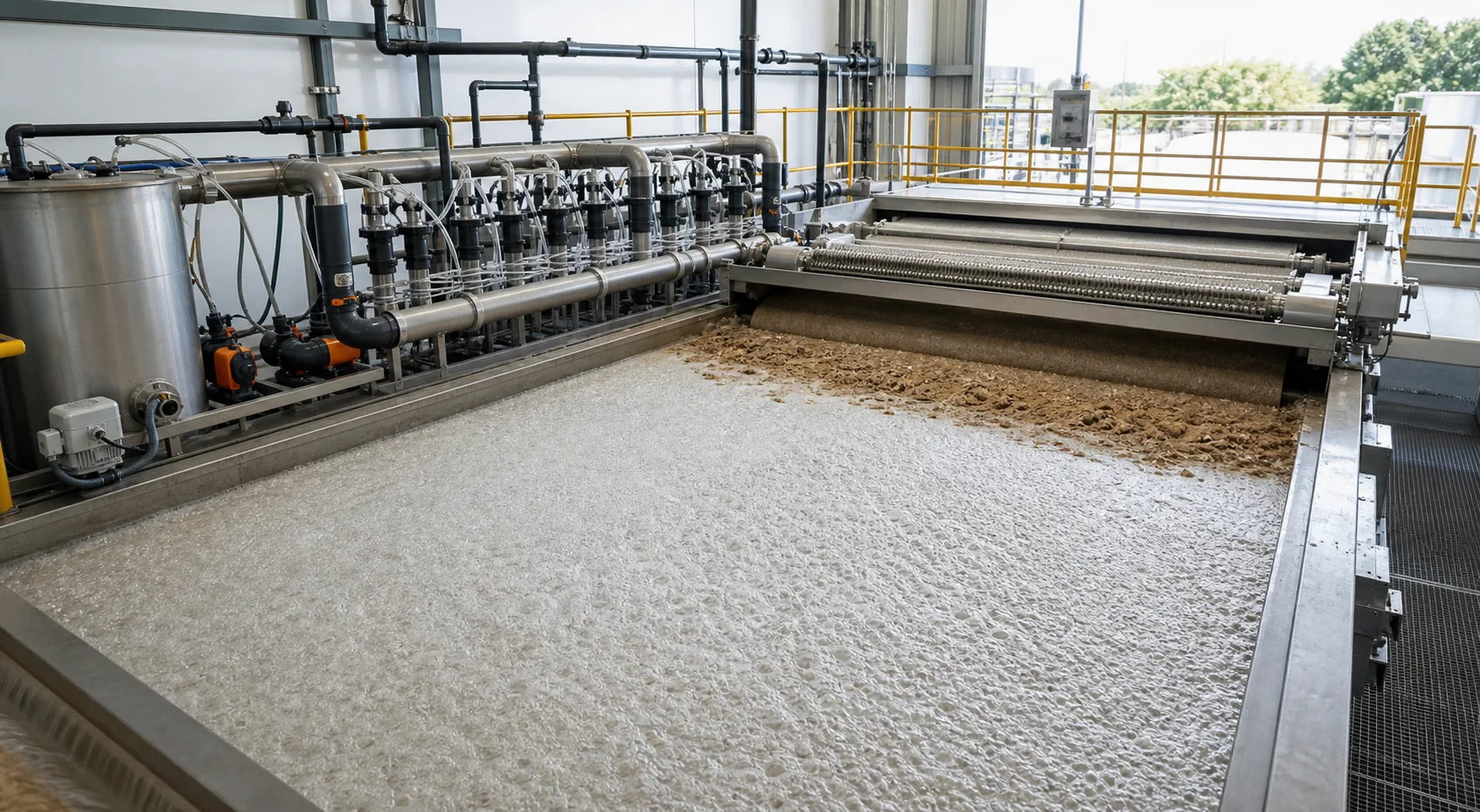
A clarifier needs floc with suitable settling velocity and compaction. DAF needs open floc that can attach to bubbles, rise and form a skimmable float layer without producing excessive recycle solids.
Use the intended separation method in bench or pilot work. A heavy floc that settles well may not be the best DAF floc, and a buoyant DAF aggregate may compact poorly in a settling test.
Read underdose and overdose separately
Underdose can leave pin floc, slow separation and turbid effluent. Overdose may create stringy floc, viscous carryover, unstable float or increased downstream fouling.
Build a full active-dose curve and repeat the promising range. Approve the lowest stable region that meets all downstream constraints rather than the single clearest beaker.
Protect the addition point
Polymer should contact destabilized particles under enough mixing to distribute the solution but not so much energy that developed chains and aggregates are destroyed. Short-circuiting at an injection quill can create local overdose and bulk underdose at the same time.
Inspect quill position, dilution flow, pipe velocity and distance to the separator. Preserve the sequence during scale-up from jar to plant.
Specify the wastewater window
A supply decision should state the wastewater source, pH, conductivity, suspended solids, oil and grease or color indicators, coagulant program and separation equipment. These are selection inputs, not after-the-fact notes.
Send representative fresh samples or current operating data with the RFQ. Xinqi can then align sample identity, documents, packing and trial quantities with the process duty.