
Map the complete chemical sequence
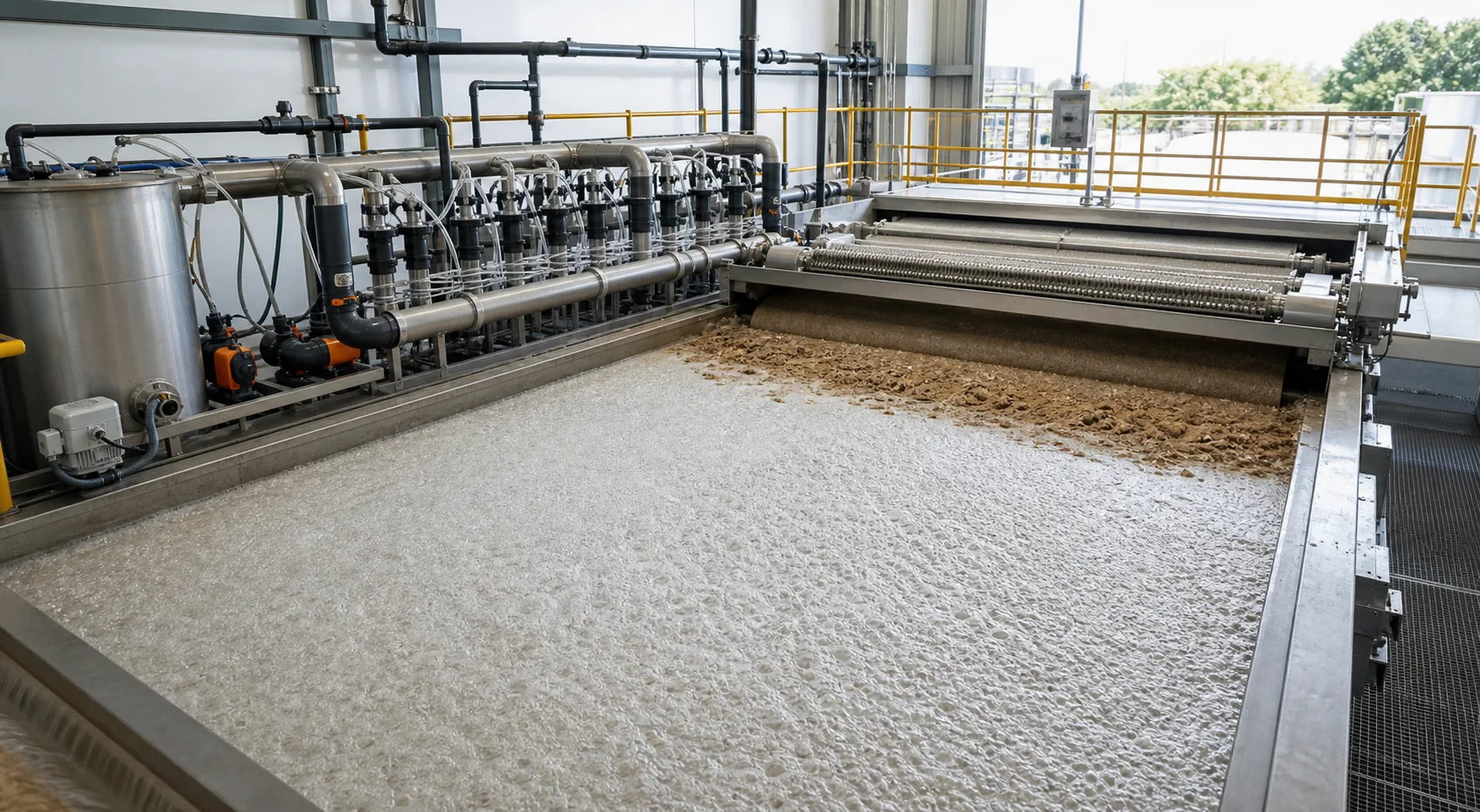
Equalization, pH correction, coagulant addition, flocculation and separation form one operating sequence. A PAM trial is not interpretable when upstream pH or coagulant residual changes between beakers.
Record each addition point, mix time, recycle condition and separation residence time. The sequence should be reproducible at bench, pilot and plant scale.
Define the solids to be removed
Food, metal-finishing, textile, paper and other industrial streams differ in oil, inorganic particles, fibers, color bodies and biological solids. One generic wastewater description is not enough for product selection.
Include TSS, turbidity, pH, conductivity and relevant process indicators such as oil and grease, color or phosphorus. Separate dissolved targets from suspended targets.
Use DAF-specific evidence
A DAF trial should observe bubble attachment, rise behavior, float layer stability, skimmability and clarified effluent. Settling alone does not reproduce flotation physics.
Test the polymer after the intended coagulant and at the intended hydraulic location. Watch for floc that is too dense, too fragile or too viscous to float and skim reliably.
Protect downstream biology
Chemical primary treatment can change organic and nutrient loading to the biological stage. Polymer and coagulant changes should be evaluated for treated-water quality, recycle solids and the response of downstream units.
Use stop limits for pH, carryover and effluent quality during plant trials. Make one controlled change at a time and allow process residence time before interpreting the result.
Calculate operating value
Delivered polymer price alone does not capture treatment value. Compare active dose, coagulant demand, sludge production, float solids, disposal volume, throughput and effluent stability.
A higher-cost product can be economical if it lowers active consumption or improves solids handling, while a low unit price can be expensive when it increases recycle load.
Prepare a useful application RFQ
Provide the flow range, wastewater source, equalization volume, chemistry, equipment, current dose, treated-water targets and destination. Attach recent data and describe short-duration upsets.
Request a small, coded screening set with product documents and preparation instructions. Preserve sample codes through the decision and quotation.