
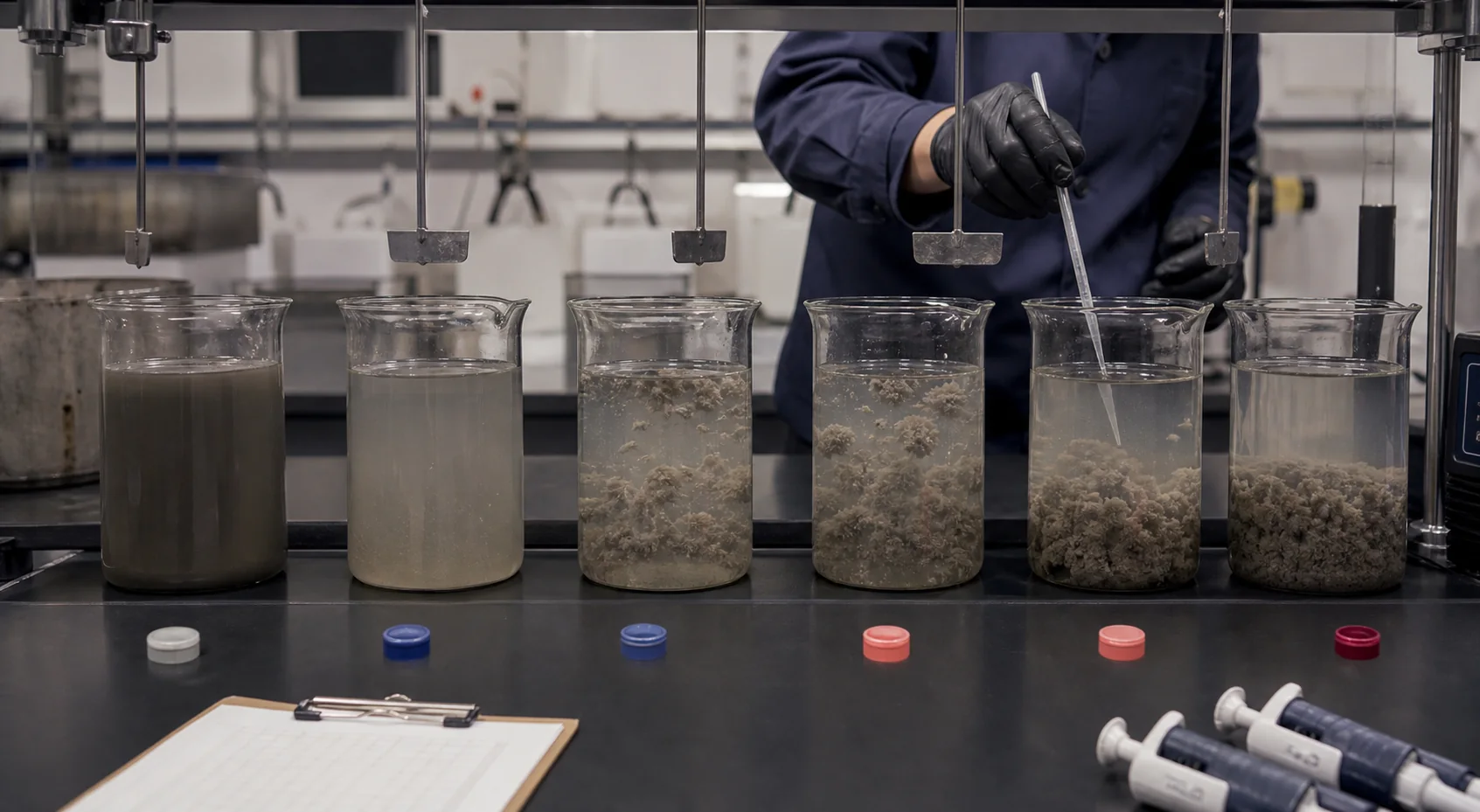
Define the product purchase
A quotation describing high charge and high molecular weight does not yet define an acceptable wastewater polymer. Those descriptions should identify a useful sample bracket, not replace the treatment comparison. Ask what each stated property means and how the offered grade connects to the actual process.
Identify the stream, separator and unresolved limitation before selecting a trial grade. Preserve the proposed commercial code so laboratory work and purchasing refer to the same material.
Clarify the property basis
Distinguish routine lot measurements, typical values and qualitative grade descriptions. Request methods and units for numerical claims, including relevant solution concentration and temperature. Do not assume neat or solution viscosity is a direct measurement of molecular weight.
Keep commercial and sample codes beside the data so a broad catalogue range cannot silently become the acceptance specification.
Choose a justified comparison
Use wastewater origin, coagulant condition and equipment to select candidate ionic profiles. The ionic-family comparison explains why a cationic label alone cannot qualify a sludge product or an anionic label a DAF product.
Require each candidate to resolve a stated uncertainty about capture, drainage, shear or dose width rather than collecting many unrelated samples.
Approve measured operating behavior
Compare preparation feasibility, active-dose response, liquid quality and separated-solids handling. Use relevant shear and the actual machine before confirming routine supply. A larger floc is not a substitute for capture or throughput evidence.
If a numerical property cannot be compared reliably between suppliers, retain it as descriptive information and award on the agreed product identity and verified duty.
Resolve a conflicting result
A nominally higher-molecular-weight candidate may create larger initial aggregates yet give poorer filtrate after transfer shear. Keep the measured output, not the catalogue superlative, in the award decision.
Retain the reference condition and repeat the comparison where sampling or instrument variability obscures the difference. Report what remains untested rather than extending one favorable response to the entire plant.
Set the release evidence
| Acceptance check | Evidence | Purchase decision |
|---|---|---|
| Properties | Defined method and status | Comparable claims |
| Samples | Codes and bracket rationale | Interpretable trial |
| Duty | Capture, handling and dose range | Performance demonstrated |
Keep preparation, calibrated active delivery, feed condition and output measurements together. Record rejected conditions as well as the accepted range so a later delivery can be assessed against a reproducible reference.
Request an application-matched offer
Send the offered data sheets, current product information, wastewater condition and separator limits. Request a small coded comparison with product-specific preparation instructions and clear exceptions.
Use the wastewater PAM sample and quotation form and review product documents and delivery controls with Gongyi Xinqi Polymer Co., Ltd.. Confirm offered grades, commercial terms and any required approvals before ordering.