
Define the product purchase
Powder and emulsion describe supplied form, not equivalent chemistry. A form change affects preparation and storage as well as the delivered active mass. Compare the candidate with the installed system and the actual wastewater requirement before treating a liquid or dry product as an interchangeable purchase.
Identify the stream, separator and unresolved limitation before selecting a trial grade. Preserve the proposed commercial code so laboratory work and purchasing refer to the same material.
Separate chemistry from preparation
Identify ionic family, commercial code, active basis and product-specific activation instructions. Powder requires controlled wetting and hydration; inverse emulsion needs a suitable inversion route. Neither process should be assumed to work in the other hardware without review.
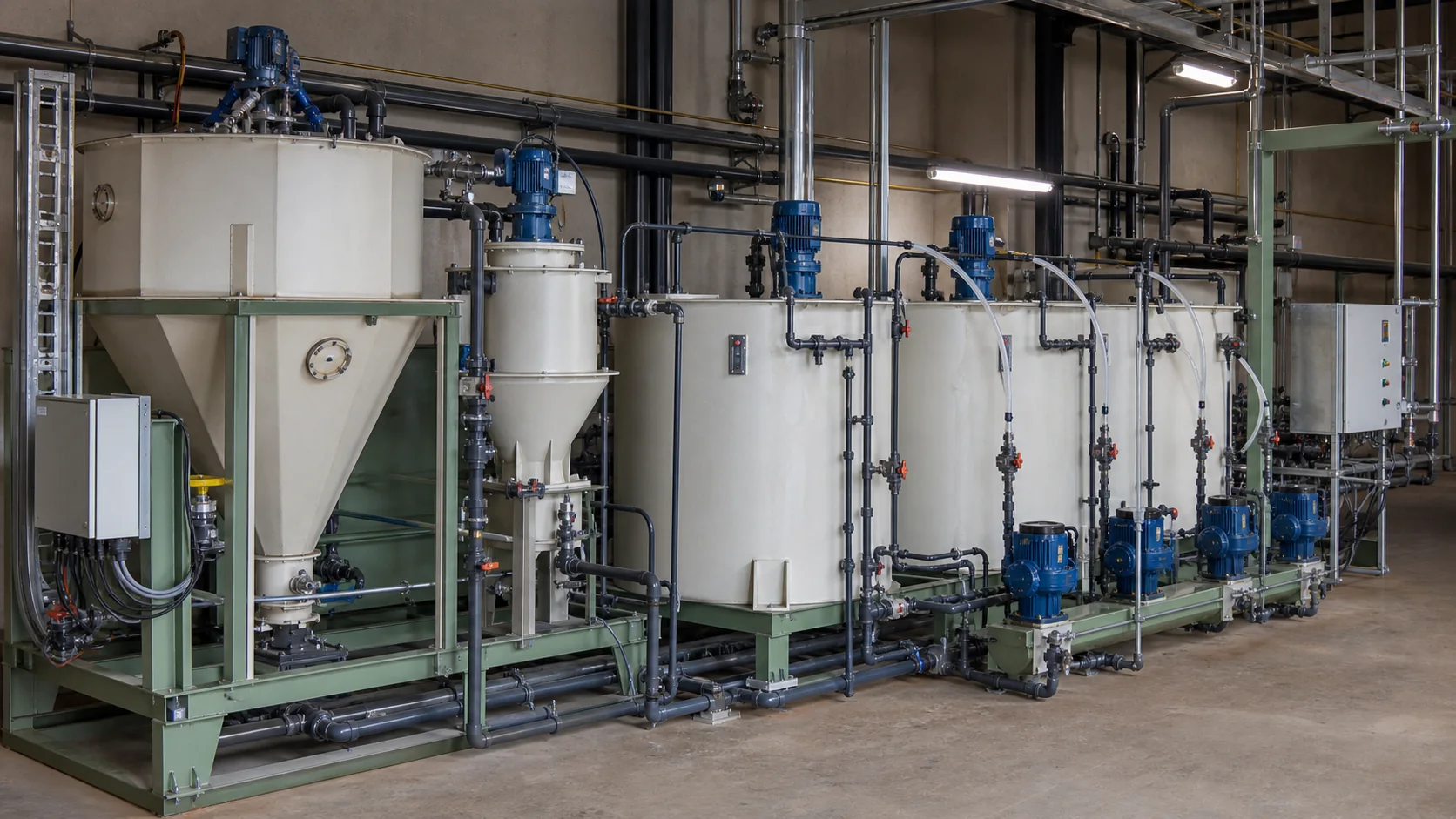
The preparation record establishes the existing powder baseline and the variables that a conversion must address.
Compare feasible peak delivery
Review available water, usable residence, metering range, transfer conditions and standby arrangements. Test the maximum required active feed as well as normal consumption. Include supplier-reviewed cleanup and changeover requirements.
A convenient hand-prepared liquid sample does not prove that an existing day tank and pump can deliver consistent activated polymer.
Award the combined operating scope
Compare equivalent accepted capture, water quality and solids handling before calculating cost. List storage footprint, handling, packaging turnover and required equipment changes separately from recurring chemical expense.
Retain safety documents for the exact formulation and a controlled first-lot plan. A form conversion should not hide an unqualified grade substitution or an uncosted preparation upgrade.
Resolve a conflicting result
If emulsion gives a faster laboratory response but the plant lacks a reliable inversion system, the offer has an equipment dependency. Price and test that dependency before approving the chemical conversion.
Retain the reference condition and repeat the comparison where sampling or instrument variability obscures the difference. Report what remains untested rather than extending one favorable response to the entire plant.
Set the release evidence
| Acceptance check | Evidence | Purchase decision |
|---|---|---|
| Form | Identity and activation requirements | Not chemistry equivalence |
| Capacity | Actual active-feed range | Plant-feasible preparation |
| Award | Accepted output plus conversion scope | Total purchase understood |
Keep preparation, calibrated active delivery, feed condition and output measurements together. Record rejected conditions as well as the accepted range so a later delivery can be assessed against a reproducible reference.
Request an application-matched offer
Send current product form, preparation layout, water supply, peak demand and separator evidence. Request a form comparison with equipment exceptions and startup requirements explicitly listed.
Use the wastewater PAM sample and quotation form and review product documents and delivery controls with Gongyi Xinqi Polymer Co., Ltd.. Confirm offered grades, commercial terms and any required approvals before ordering.