
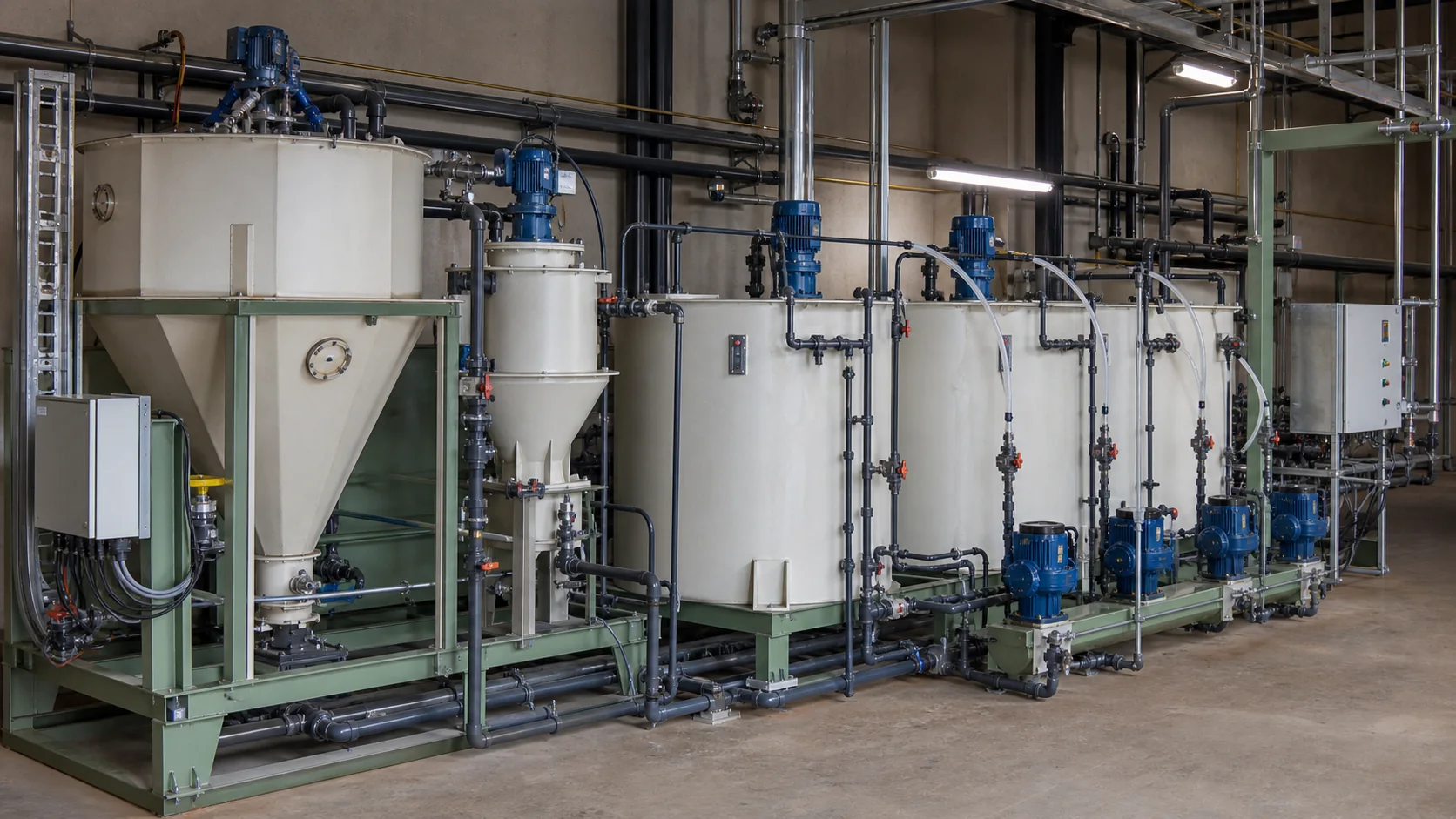
Start with usable preparation water
Water temperature, hardness, suspended solids and residual oxidants can affect dissolution and solution stability. Use a consistent source and record material changes.
Confirm that water pressure and flow remain stable across feeder operation.
Wetting is the first control point
Dry powder must contact water evenly so particles disperse before their surfaces gel. Dumping powder into a tank promotes fish-eyes and hidden inactive mass.
Calibrate the feeder, wetting cone and primary water flow as one system.
Use controlled concentration
Excessively concentrated stock can mix poorly and overload pumps; unnecessary dilution consumes tank capacity. Choose a concentration compatible with the product and equipment.
Verify concentration from measured powder and water delivery rather than controller settings alone.
Provide enough aging
Polymer chains need time to hydrate after wetting. Short-circuiting between make-down and day tank produces an inconsistent active response.
Confirm tank volume, level logic, mixer operation and actual residence time at the current demand.
Avoid destructive mixing
Initial dispersion needs energy, but prolonged high shear can damage developed solution. Slow mixing should preserve uniformity without beating the polymer.
Inspect mixer speed, recirculation and transfer pumps when performance changes after maintenance.
Manage solution age
Prepared solution should be used within the supplier's applicable window and protected from contamination. Long storage can reduce consistency and create housekeeping problems.
Use first-in, first-out operation and clean tanks before deposits affect the next batch.
Protect dry product storage
Dry PAM is sensitive to moisture and damaged packaging can create lumps before material reaches the feeder. Store sealed bags off the floor in a dry area and rotate stock by lot.
Inspect pallets, liners and bag closures at receiving and before make-down.
Control housekeeping and operator exposure
Spilled dry or wet polymer can create an extremely slippery surface. Use the applicable SDS, enclosed transfer where practical and a defined spill-cleaning method.
Keep wash water from carrying concentrated polymer into unintended drains or process units.
Calibrate metering and dilution
Measure pump output against stroke or speed and verify secondary dilution flow. Backpressure and solution viscosity can change delivered volume.
Check valves, quills and small tubing for restriction, especially after a gel event.
Record every prepared batch
Log product code, lot, powder mass, water volume, start time, aging release time and observed solution condition. Associate the batch with the process trial or operating shift.
This record helps distinguish a supply change from a preparation change when performance moves later.
Inject for distribution, not convenience
The easiest pipe location may not provide uniform contact or enough low-shear time. Match the point to the intended chemical sequence and separator.
Document the route, pipe velocity and distance to the process so a trial can be reproduced.
Audit preparation before product change
When treatment drifts, compare a freshly prepared reference solution, feeder calibration and active dose before replacing the grade.
This separates product selection from a correctable equipment or operating fault. Retain the batch record with the associated wastewater sample and separator result.