
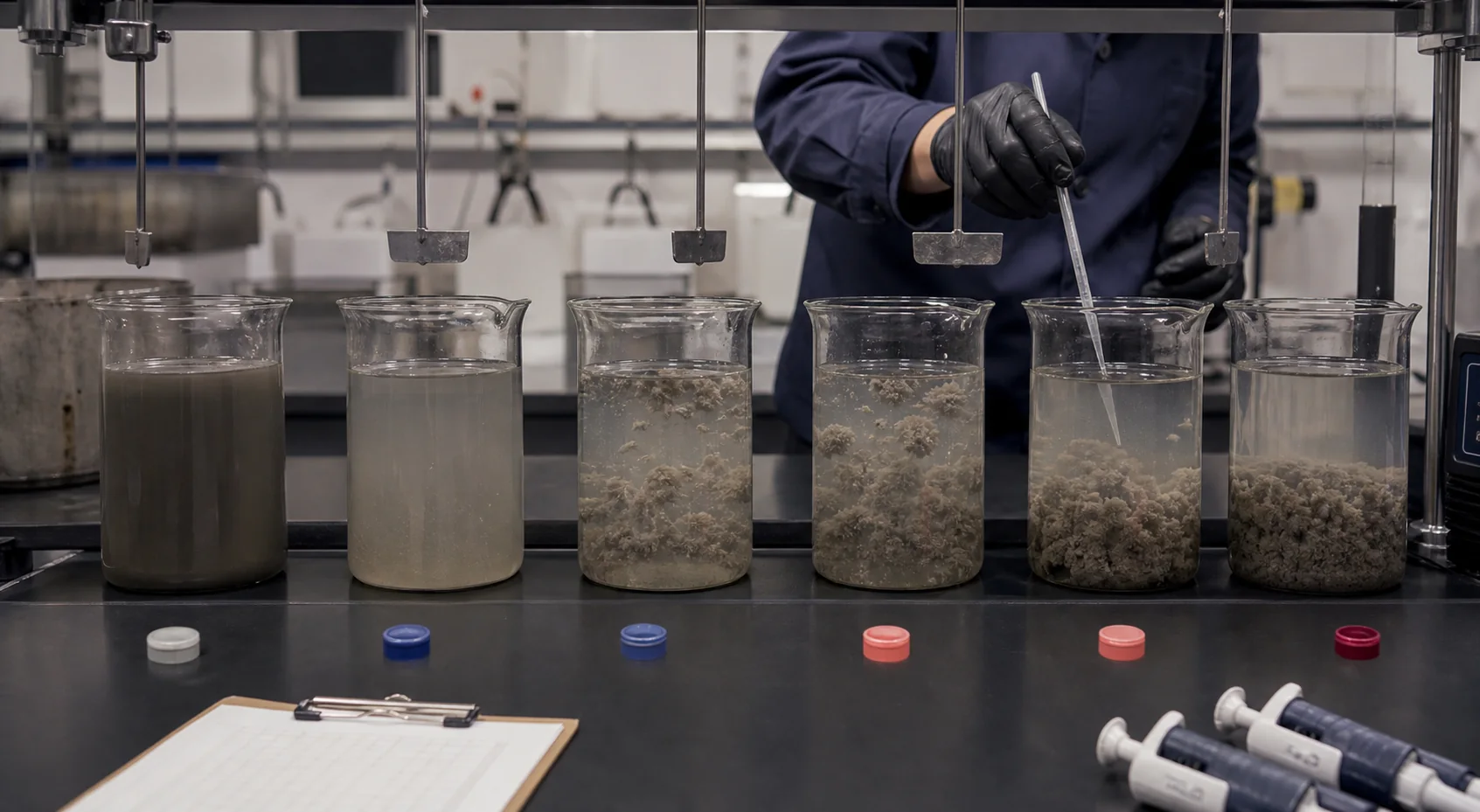
Treat nonionic PAM as a trial route
Low-charge products can be useful when ionic interactions are suppressed or when an acidic, saline or compositionally unusual stream produces poor response with standard charged families. The label does not predict success by itself.
Screen nonionic candidates beside at least one appropriate anionic or cationic reference at equal active dose. A side-by-side response prevents a special-case product from becoming the default without evidence.
Measure the water matrix
Conductivity, multivalent ions, pH, surfactants and dissolved organics can alter chain extension, adsorption and floc strength. A composite sample may hide a short-duration load that controls full-scale failure.
Use time-resolved plant data and collect samples that represent normal and difficult operation. Mark sample age and preservation because biological and chemical changes continue after collection.
Separate color or COD goals from solids capture
Polyacrylamide primarily supports solid-liquid separation; it does not guarantee removal of dissolved color or soluble COD. Coagulation, oxidation, adsorption or biological treatment may be responsible for those endpoints.
Record suspended solids and turbidity separately from dissolved measurements. Approve the polymer for the task it actually performs and keep upstream chemistry in the treatment record.
Challenge the product with real shear
A low-charge chain may show attractive floc in gentle mixing but lose performance across a transfer pump, inline mixer or flotation recycle contact point. Bench work should include a controlled shear challenge.
Compare floc before and after shear and observe recovery. If recovery is weak, review molecular profile, dose, addition point and mixing intensity together.
Confirm solution quality
Nonionic powder still requires controlled wetting, dissolution and aging. Fish-eyes or undissolved material can block small lines and make the dose calculation meaningless.
Inspect solution for gels, screen residue and concentration consistency. Calibrate the powder feeder and solution pump before the plant trial.
Purchase against an approved operating record
The RFQ should identify the approved sample, active basis, solution preparation, wastewater range and measurable endpoints. Packaging and storage conditions matter because moisture exposure can damage dry polymer handling.
Request sample-to-production traceability, COA, SDS, packing, lead time and destination terms. Revalidate if the process matrix or supply identity changes.