
Define the product purchase
An acidic pH or high conductivity reading does not automatically make nonionic PAM the correct purchase. Unusual water chemistry can justify a low-charge comparison, but the actual solids, ions and upstream treatment determine the useful response. Require evidence rather than a special-grade label.
Identify the stream, separator and unresolved limitation before selecting a trial grade. Preserve the proposed commercial code so laboratory work and purchasing refer to the same material.
Characterize the real matrix
Provide pH, conductivity, temperature, solids source and available information about relevant dissolved ions and process additives. Distinguish a stable stream from short cleaning or concentrated-discharge events.
Conductivity signals dissolved ionic content but does not identify every ion or predict adsorption and chain behavior by itself.
Compare plausible profiles fairly
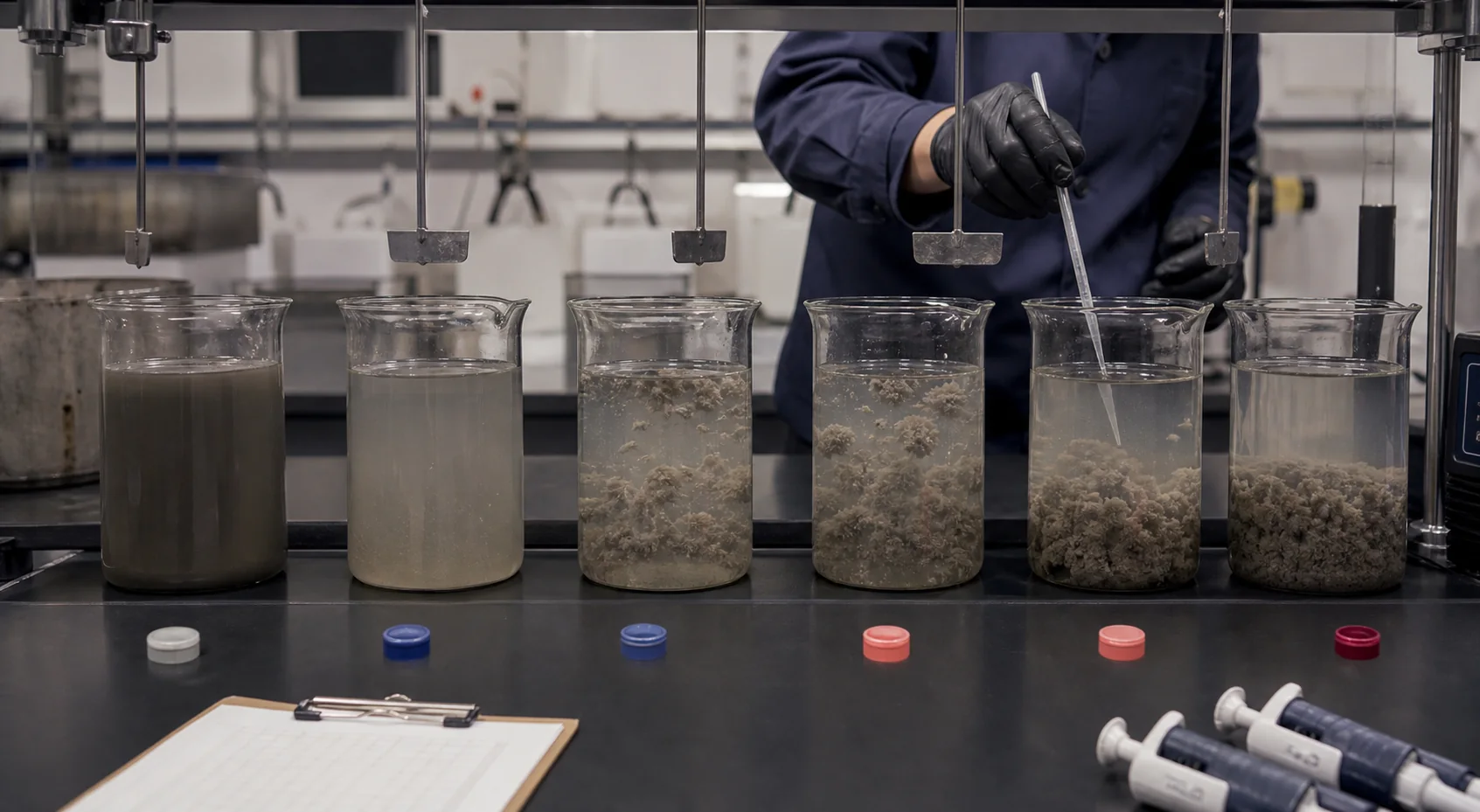
Use the nonionic screening route beside a justified charged reference. Document actual preparation water, active basis, aging and addition sequence.
A candidate that works in fresh preparation water still needs confirmation on the treated stream, while recycled preparation water creates an additional compatibility question.
Bound the supplied recommendation
Measure the actual settling, flotation or drainage endpoint across relevant matrix states. Carry useful conditions into the installed equipment and note any required pretreatment or water supply change.
Do not write an unlimited salt- or acid-resistance guarantee from one sample. Preserve the tested range and conditions requiring a repeat screen.
Resolve a conflicting result
If a low-charge candidate helps one acidic batch but loses capture after the coagulant program changes, retain that limitation. The original pH label is not evidence of universal industrial compatibility.
Retain the reference condition and repeat the comparison where sampling or instrument variability obscures the difference. Report what remains untested rather than extending one favorable response to the entire plant.
Set the release evidence
| Acceptance check | Evidence | Purchase decision |
|---|---|---|
| Matrix | Ions, solids and batch context | Representative feed |
| Bracket | Low-charge and reference codes | Hypothesis tested |
| Range | Relevant chemistry states | Supply claim bounded |
Keep preparation, calibrated active delivery, feed condition and output measurements together. Record rejected conditions as well as the accepted range so a later delivery can be assessed against a reproducible reference.
Request an application-matched offer
Send water and solids data, coagulant sequence, preparation conditions and equipment constraints. Ask for a justified candidate bracket and explicit operating boundaries before ordering.
Use the wastewater PAM sample and quotation form and review product documents and delivery controls with Gongyi Xinqi Polymer Co., Ltd.. Confirm offered grades, commercial terms and any required approvals before ordering.