
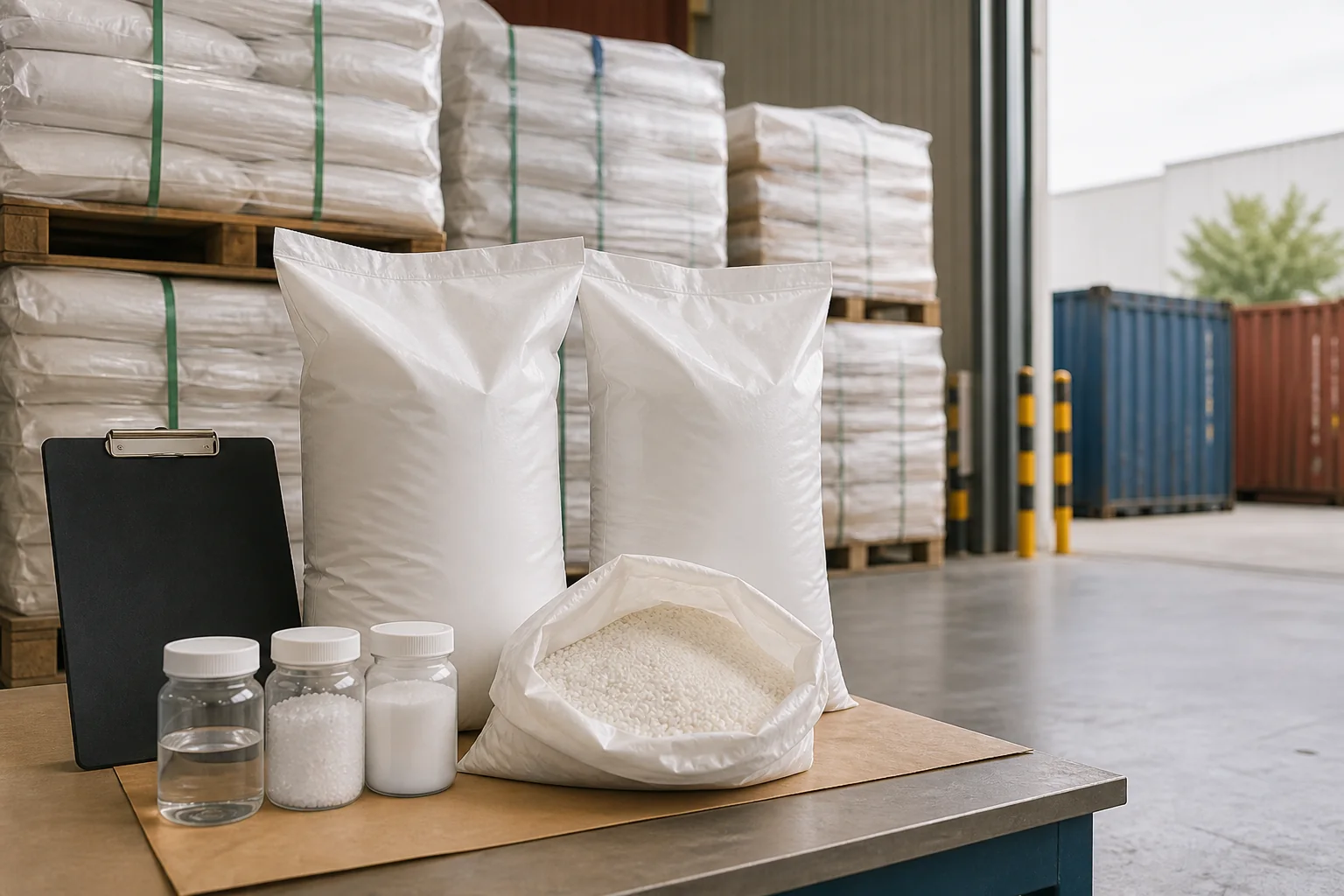
Define the product purchase
For sludge conditioning, a lower product price is not automatically a lower treatment cost. Procurement should compare an accepted dry-solids throughput at a common capture and handling requirement. State whether the quoted material is powder, emulsion or solution before normalizing its price.
Identify the stream, separator and unresolved limitation before selecting a trial grade. Preserve the proposed commercial code so laboratory work and purchasing refer to the same material.
Normalize delivered active cost
Align currency, net mass, destination and delivery term. Divide cost per product kilogram by the agreed active-polymer fraction. Keep total-solids claims separate from active-polymer content unless the supplier defines their relationship.
If liquid delivery is measured volumetrically, use the supported density; litres of formulation are not kilograms of active polymer.
Use a calibrated dry-solids denominator
Measure feed flow and solids over a matched interval and calculate active kg per dry tonne. The dose calculation record prevents a thin-feed shift from appearing to consume a better grade.
Chemical cost per dry tonne equals active kg per dry tonne multiplied by cost per active kg. Keep assumptions and measurement uncertainty visible.
Include the accepted plant result
Compare cake solids, capture, throughput and recycle-liquid consequences. Separate recurring chemical expense from preparation changes, equipment costs and trial support. Avoid adding unlike or unverified savings into one precise number.
A small chemical saving may not survive increased disposal mass or reduced machine capacity. Keep those outcomes in the purchasing comparison rather than reporting price per bag as treatment value.
Resolve a conflicting result
A product that lowers active consumption but returns more solids in centrate may increase the plant recycle burden. Confirm a common accepted capture condition before treating the lower dose as a saving.
Retain the reference condition and repeat the comparison where sampling or instrument variability obscures the difference. Report what remains untested rather than extending one favorable response to the entire plant.
Set the release evidence
| Acceptance check | Evidence | Purchase decision |
|---|---|---|
| Price | Mass, active basis and delivery term | Comparable purchased units |
| Usage | Calibrated active kg/dry tonne | Common loading basis |
| Value | Capture, cake and capacity | Accepted treatment compared |
Keep preparation, calibrated active delivery, feed condition and output measurements together. Record rejected conditions as well as the accepted range so a later delivery can be assessed against a reproducible reference.
Request an application-matched offer
Send quotations, active-content definitions, calibrated use, feed-solids records and accepted machine outputs. Ask for transparent assumptions instead of a guaranteed saving based only on product price.
Use the wastewater PAM sample and quotation form and review product documents and delivery controls with Gongyi Xinqi Polymer Co., Ltd.. Confirm offered grades, commercial terms and any required approvals before ordering.