
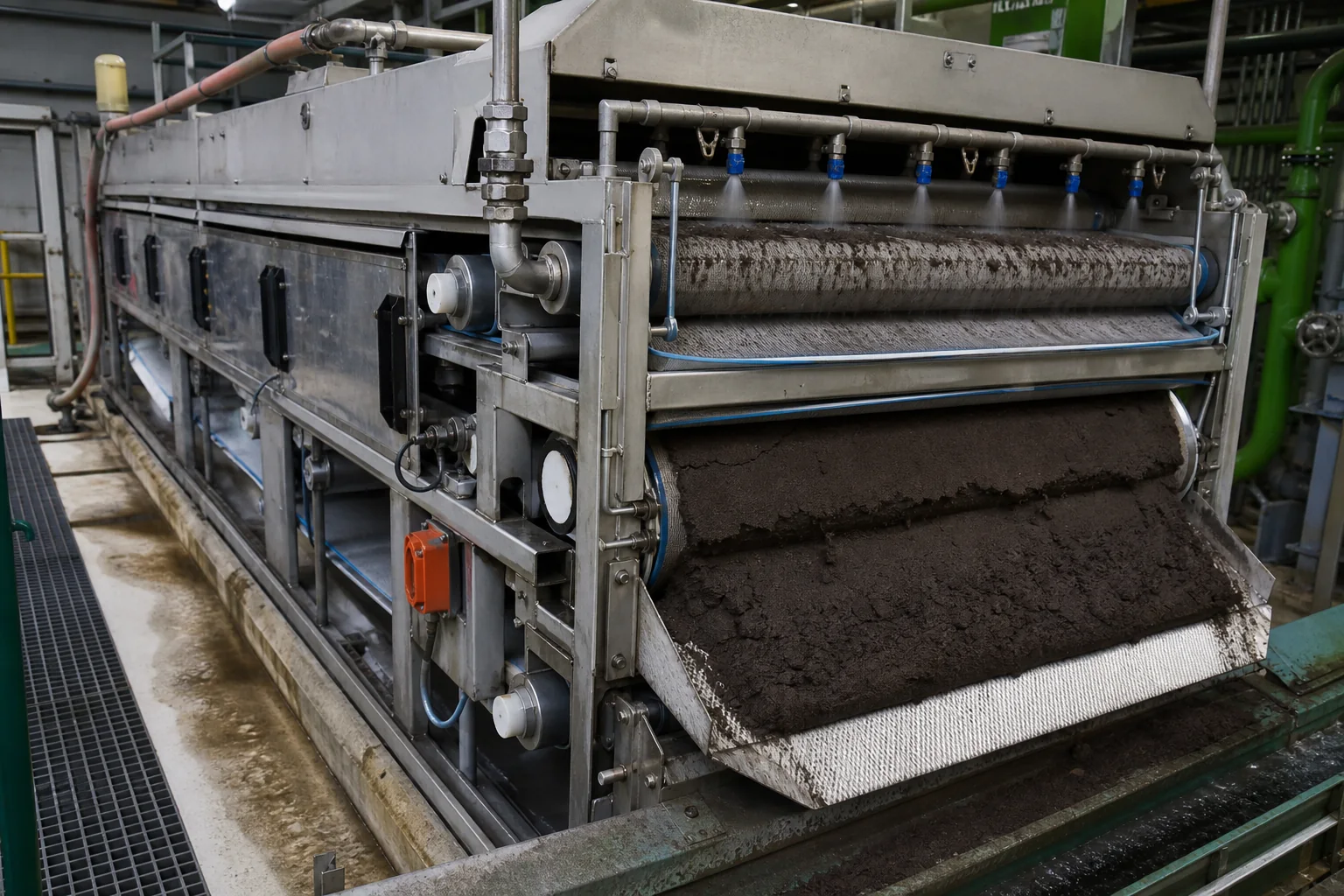
Start with the sludge, not a charge label
Waste activated sludge, primary sludge, digested sludge and industrial biological sludge present different surface charge, water binding and shear response. A cationic family is a logical screening route for many organic residuals, but the winning grade must be demonstrated on the current sludge.
Record feed solids, volatile fraction, pH, conductivity, temperature, storage time and upstream chemistry. These variables explain why the same press can require a different product after a process or seasonal change.
Match charge demand before molecular reach
Cationic sites can neutralize negatively charged sludge surfaces while the polymer chain builds a drainable network. Excess charge can create sticky, weak or dispersed solids rather than a stronger cake.
Screen at least several charge profiles at equal active dose. Compare drainage, floc resilience, filtrate solids and cake release instead of selecting from floc size alone.
Use the dewatering machine as a test condition
A belt press rewards rapid free drainage followed by a cake strong enough to tolerate compression. A centrifuge exposes conditioned floc to acceleration and shear, while a screw press requires drainage through a different mechanical path.
Preserve the real feed point, dilution water, mixing energy and residence time during trials. A product that performs in a quiet beaker may fail after a high-shear pump or long transfer line.
Normalize dose on dry solids
Liquid flow alone does not describe polymer demand when feed solids vary. Report active polymer mass per unit dry solids and keep the product active content in the calculation.
Track cake solids, solids capture, filtrate or centrate quality, throughput and polymer cost together. The lowest dose is not economical if it raises recycle loading or disposal volume.
Inspect preparation before changing product
Undispersed powder, insufficient aging, hard dilution water, excessive solution concentration and damaged pumps can make a suitable grade appear ineffective. Confirm preparation water flow, wetting, tank volume and solution age before escalating dose.
Use a fresh reference solution during diagnosis. If the reference restores response, repair the make-down or dosing path before restarting product selection.
Define the sample and supply record
A useful product trial links the sample code to ionic family, active content, preparation method, lot and application conditions. Request current COA and SDS documents for the proposed supply identity.
For quotation, include monthly quantity, bag or pallet preference, destination, trial timing and required documents. Xinqi can use that record to propose a bounded screening set rather than a universal grade claim.