
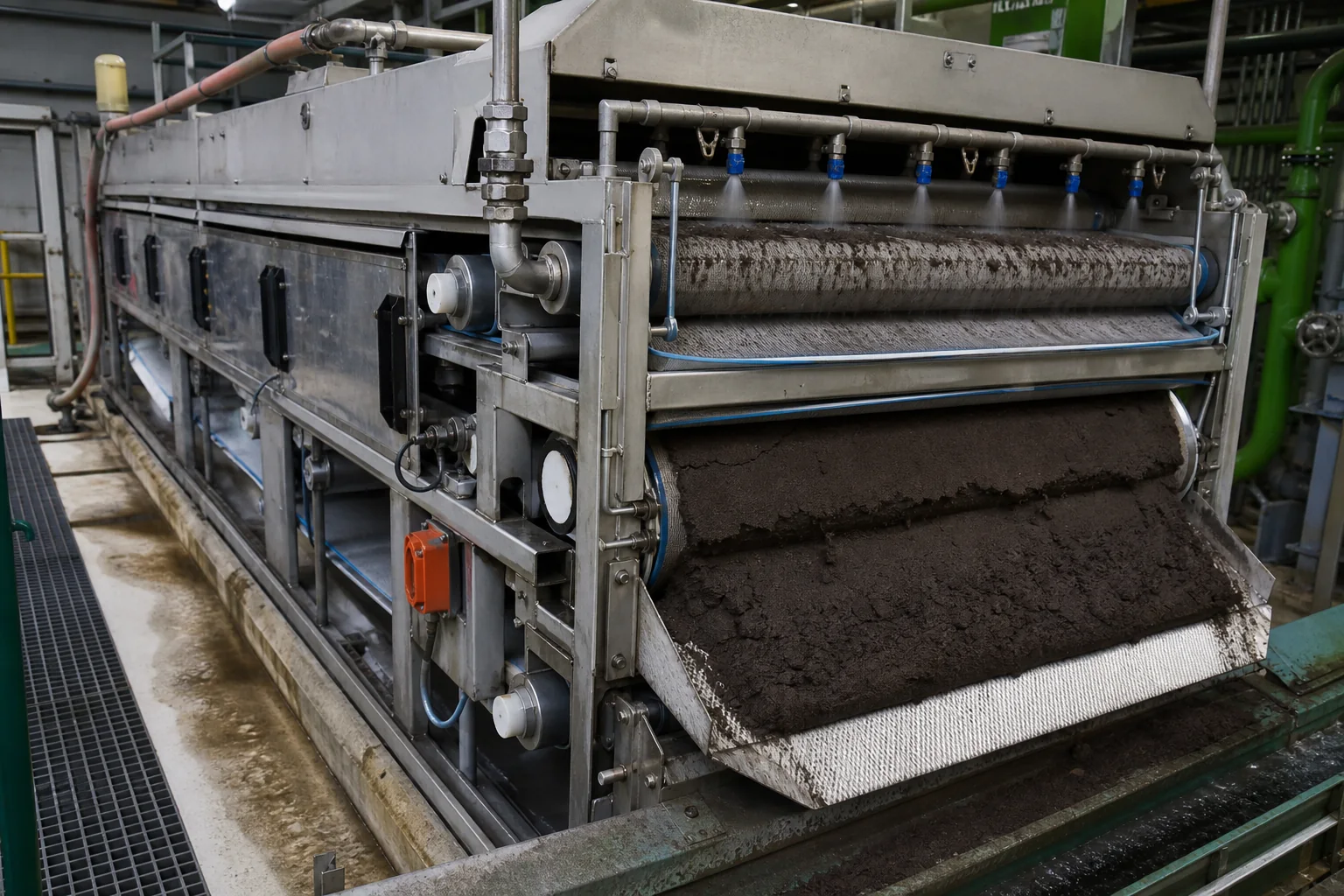
Identify the sludge entering dewatering
Waste activated sludge, mixed primary and secondary sludge, aerobically digested sludge and anaerobically digested sludge do not have the same conditioning demand. Storage time and upstream nutrient-removal chemistry can shift response further.
Track feed solids, volatile fraction, pH, temperature, conductivity and recent process events. These inputs should travel with every screening sample.
Screen polymer against the machine
Use drainage or capillary tests for initial ranking, then confirm on the actual belt press, centrifuge or screw press. Machine shear, drainage geometry and solids loading can reverse a bench ranking.
Preserve solution concentration and addition point. Record feed rate, bowl or belt settings and wash-water conditions during every controlled run.
Measure solids capture and recycle load
Cake dryness is valuable, but poor capture can send solids and polymer back to the headworks. Filtrate or centrate quality is part of the dewatering result.
Compare cake solids, capture, throughput, polymer active dose and recycle clarity together. Use several steady-state samples rather than one visual observation.
Recognize conditioning faults
Small weak floc and slow drainage suggest under-conditioning, poor preparation or excess shear. Sticky floc, blinding, uneven belt loading or deteriorating centrate can indicate overdose or the wrong charge profile.
Change one variable at a time and return to a known reference condition. A trend across a dose curve is more reliable than a single operator adjustment.
Preserve the approved window
A good program defines the sludge range, product code, dose range, solution strength, aging time, addition point and equipment settings that produced the result.
Re-screen after major changes in digestion, industrial contribution, storage time, equipment or product identity. Do not assume an old grade remains optimal indefinitely.
Quote the complete dewatering duty
Send dry-solids throughput, operating hours, current product form, monthly demand, packaging preference, discharge destination and document needs. Include the machine type and current performance.
Xinqi can align coded samples, COA/SDS availability, packing and commercial terms with the approved operating evidence.