
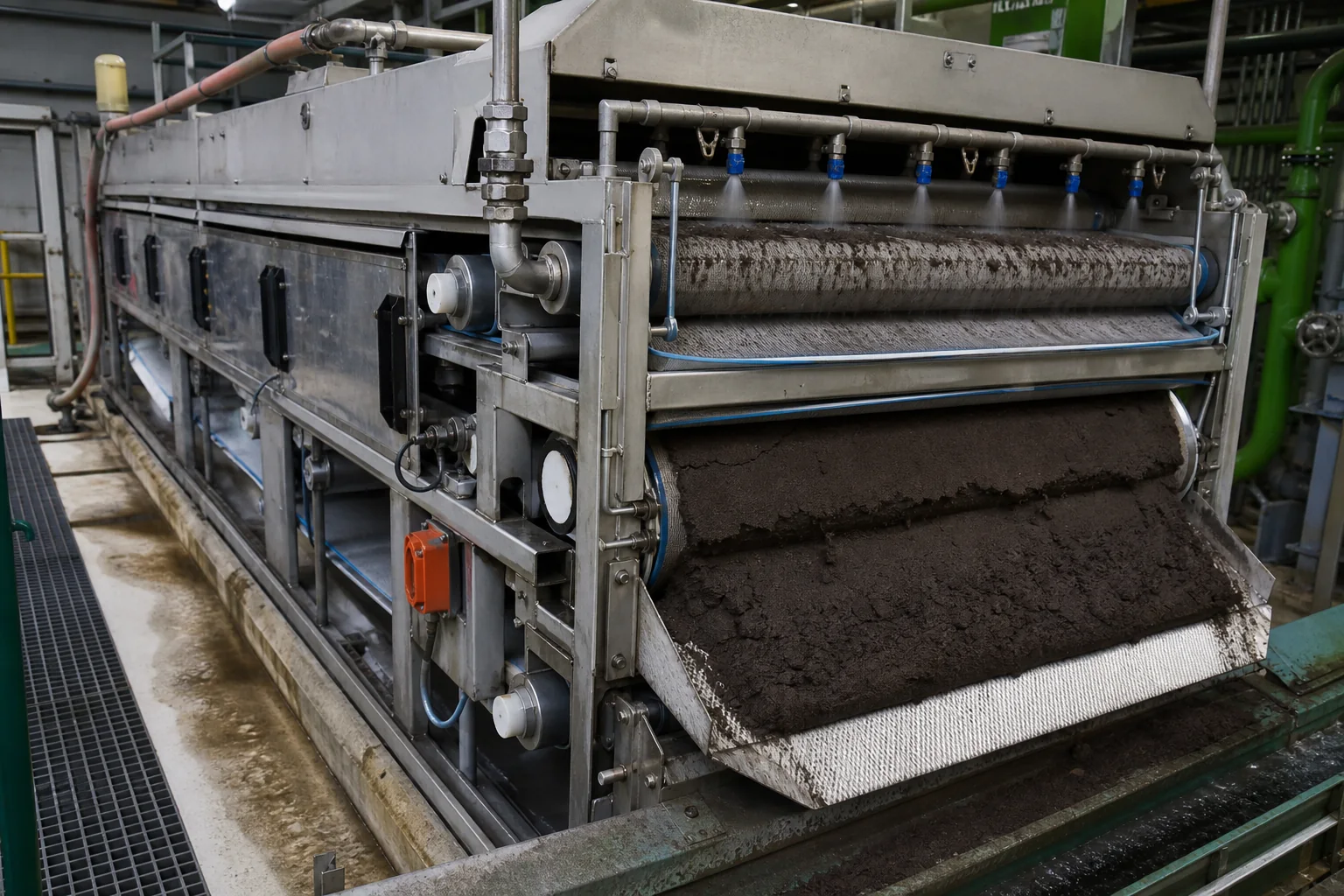
Define the product purchase
For a belt filter press, rapid drainage is valuable only if the conditioned solids remain manageable through compression and release. A purchase should define the whole belt duty and the physical baseline. A polymer cannot be assumed to repair worn cloth, blocked wash nozzles or uneven feed distribution.
Identify the stream, separator and unresolved limitation before selecting a trial grade. Preserve the proposed commercial code so laboratory work and purchasing refer to the same material.
Record the belt operating baseline
Identify sludge blend, feed solids, preparation, conditioning point and relevant belt settings. Inspect washing, cloth condition and loading before comparing candidates.
The troubleshooting record prevents an equipment fault from being converted into an unsupported demand for more polymer.
Use drainage as a screen, not the award
Compare controlled active-dose points with repeatable preparation and observation timing. Check filtrate solids and floc handling beside free-water release. Carry leading conditions into the machine.
A candidate producing very fast initial drainage may still show squeeze-out, poor cake formation or unstable release under actual compression.
Approve a maintainable dose range
Measure capture, cake solids, throughput and belt release over stable operation. Keep wash-water and relevant machine differences visible when calculating delivered treatment cost.
An isolated best cake sample is weaker evidence than a repeatable operating plateau that operators can maintain as feed varies.
Resolve a conflicting result
If additional polymer gives slightly drier cake but causes sticky release or worse filtrate, compare the complete dose curve and inspect the machine. Do not award the higher-dose point solely for its cake-solids number.
Retain the reference condition and repeat the comparison where sampling or instrument variability obscures the difference. Report what remains untested rather than extending one favorable response to the entire plant.
Set the release evidence
| Acceptance check | Evidence | Purchase decision |
|---|---|---|
| Baseline | Belt, wash and feed condition | Comparable physical duty |
| Screen | Drainage plus liquid solids | Initial ranking credible |
| Release | Cake, capture and belt behavior | Whole-machine acceptance |
Keep preparation, calibrated active delivery, feed condition and output measurements together. Record rejected conditions as well as the accepted range so a later delivery can be assessed against a reproducible reference.
Request an application-matched offer
Send sludge and belt data, current chemistry, wash conditions and operating targets. Request samples with the agreed machine confirmation and commercial-code traceability.
Use the wastewater PAM sample and quotation form and review product documents and delivery controls with Gongyi Xinqi Polymer Co., Ltd.. Confirm offered grades, commercial terms and any required approvals before ordering.